Does AI Content Transparency Affect SEO? Will telling readers you used AI hurt your rankings? Here’s what Google has actually said, what detectors get wrong, and how to publish without the guesswork.
An editor friend called me a few months ago, pretty stressed out. Her publisher wanted every AI-assisted post labeled. Their SEO contractor insisted that would tank rankings overnight. Neither one had actual proof, just strong opinions pulling in opposite directions, and she had to make a call before Monday’s meeting.
I get why this keeps coming up. Publishing norms feel like they shift every few weeks, readers are more suspicious than they used to be, and nobody wants to be the site that loses half its traffic because of one sentence under the byline.
So let’s actually look at this instead of guessing. What has Google said, specifically? What can a detector tell you, and where does it just make stuff up? And if you run a blog, or you’re the one person at your company who writes everything, what should you do about it on Monday?
Three different things, usually lumped together
People talk about this like it’s one topic, but it’s really three.
Disclosure is telling readers AI had some role in making a piece — could be one line, could be a whole policy page. Detection is software guessing whether text came from a model. Quality is whether the page is accurate and actually useful, regardless of who typed the first draft.
Disclosure is about honesty. Detection is a guess, sometimes a decent one, sometimes not. Quality is what actually determines how your content performs. Most of the arguments I’ve seen online about AI content transparency fall apart the second you separate these three things, because people are usually arguing past each other about different ones.
What Google has actually said
Since the February 2023 guidance, Google’s position hasn’t really moved: it wants content that helps people, and it genuinely doesn’t care whether a human or a model wrote the first draft. What it cares about is content made at scale mainly to grab rankings.
In March 2024 there was a spam policy update naming “scaled content abuse” specifically. That’s mass-producing low-value pages to rank for search terms. Doesn’t matter if a chatbot wrote them, an outsourced content farm cranked them out, or someone lightly reworded a Wikipedia article. The violation is the behavior, not the tool used to do it.
There’s also Google’s “Who, How, and Why” framework in its helpful content guidance. The “how” piece is where disclosure comes in — if a reader would reasonably expect to know AI was involved, say so. That’s a nudge toward honesty. It’s not a hidden ranking switch. I haven’t found anything from Google saying a label helps you rank, and nothing saying it hurts you either. People just assume one or the other because it’s a satisfying story.
Does disclosing AI use actually hurt rankings?
Not directly, no. There’s no evidence, and honestly no plausible mechanism, where a crawler reads “written with AI assistance” and quietly knocks your page down a few spots.
But it can move things indirectly, and it cuts both ways.
Say you’ve got a thin 500-word post with “Written by AI” slapped across the top, saying nothing anyone couldn’t find in five other places. Readers bounce fast. That pattern, repeated across a site, does eventually show up in how pages perform. The label isn’t really the issue here though — the weak content is, and it would’ve bounced readers with or without the label.
Now the opposite case. A specific, honest note like “an AI tool drafted the outline, our staff dietitian reviewed every claim, and we checked the stats against the original studies” tends to build confidence rather than kill it. People respond well to transparency when there’s clearly real effort behind it. And that trust shows up in things search engines actually reward — repeat visits, branded searches, people linking to you because they believe what you wrote.
So transparency works more like a multiplier than a lever. It makes good content more believable and does nothing to save bad content.
Why a detector score isn’t something to lose sleep over
I’ve watched people stare at a 72% reading from some AI content detector and seriously consider scrapping a perfectly fine article. Don’t do that.
These tools measure statistical predictability — basically, how likely each word is to follow the last one based on patterns common in machine output. That’s it. They have no idea who actually wrote anything, which causes real problems.
Clean, simple sentences get flagged constantly even when a person wrote every word of them. A Stanford study from 2023 found detectors disproportionately flagged essays from non-native English speakers, mostly because their sentence patterns read as more “regular.” Meanwhile AI text that’s been lightly edited slides through all the time. Run one paragraph through three tools and don’t be surprised to see 15%, 48%, and 81% come back. Even OpenAI gave up on its own classifier in mid-2023, quietly, because the accuracy just wasn’t good enough to trust.
None of this makes an AI detection tool useless, to be fair. It’s genuinely decent at flagging flat, repetitive passages in your own draft. Think of it less like a lie detector and more like a smoke alarm that sometimes goes off because you burned the toast. Useful, but imperfect, and definitely not something Google is checking before it ranks you.
A clear policy on AI Content Transparency helps protect your brand from backlash.
So where does transparency actually matter?
If it’s not a ranking factor, why bother at all? A few reasons, and none of them involve pleasing an algorithm.
Trust, mostly. If someone later finds out that content they assumed a person wrote came entirely from a model, that tends to get screenshotted and shared in a way that’s not flattering for you. Trust is slow to build and fast to lose — this isn’t a new idea, but it’s especially true online right now.
Sensitive topics deserve extra care. Health, money, legal advice — anywhere a wrong answer could genuinely hurt someone. This is where Google’s quality raters look harder anyway, and frankly where you should hold yourself to a higher standard regardless of what Google thinks. If AI helped draft something about dosages or deductions, name the human who actually checked it.
Writesonic and similar tools are adding features that support AI Content Transparency.
Regulation is catching up, too, slower than people expected but it’s happening. The EU’s AI Act includes disclosure requirements for some AI-generated content. The FTC finalized rules in 2024 going after fake and AI-generated reviews. YouTube and Meta now ask creators to label realistic synthetic media. Maybe none of that touches your blog today. But the direction is obvious, and getting ahead of it costs you almost nothing.
And honestly, writing down an actual internal policy — here’s where we use AI, here’s where we don’t — tends to improve quality across the board, mostly because it forces your team to actually think about the process instead of winging it every time someone’s on deadline.
None of this is about gaming Google. It’s about building something people can rely on, which happens to be the same thing Google claims to want anyway.
The real risk isn’t AI, it’s scale
Every site I’ve seen get hit hard in a recent update wasn’t punished for saying “we use AI.” It got punished for publishing three hundred nearly identical articles chasing slight keyword variations, with nothing original in any of them.
You’ve probably seen it. Fifty posts about “best X for Y” that all say the same three things reshuffled. No real examples anywhere. Statistics that, if you bother checking the source, don’t say what the article claims, or don’t exist at all. No author name, no way to contact anyone, zero accountability.
Meanwhile plenty of sites lean on AI for research and rough drafts, then add actual expertise, careful fact-checking, and a real editorial voice on top — and their traffic has held up fine, sometimes grown. The tool isn’t what separates these two groups. What people did with it is.
Using a checker without obsessing over the number
Used right, an AI content checker sharpens your editing. Used as some kind of pass-fail gate, it just wastes an afternoon and probably makes your writing worse.
Run a draft through one early, before you’ve over-polished it. Look at whatever paragraphs score highest and ask yourself why, honestly. Usually it’s not mysterious — generic phrasing, sentences that are all the same length, claims with nothing specific backing them up. Real writing problems, whether or not software flags them.
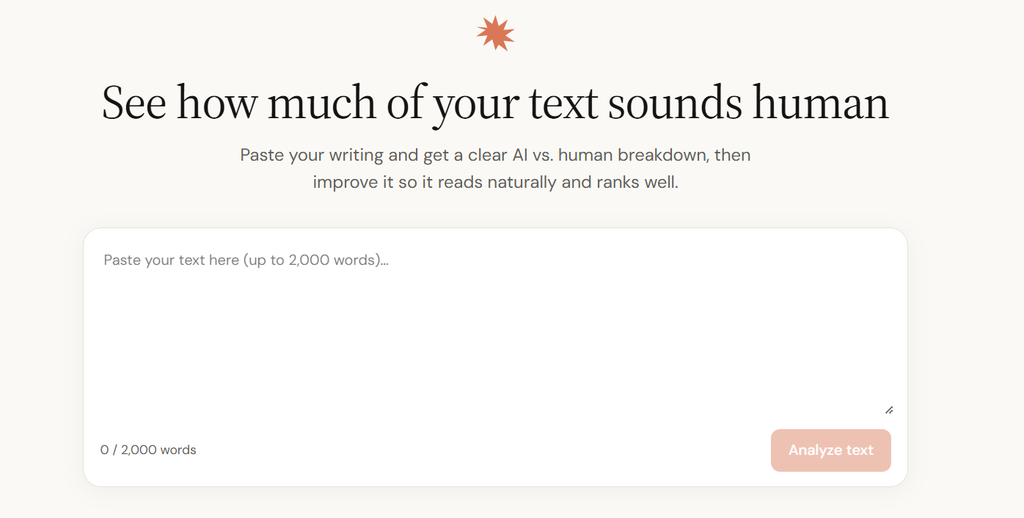
I’d also push back on trusting a flat “AI or human” verdict. It’s a blunt tool. What’s more useful is knowing roughly how much of a piece leans on machine-like patterns, so you know where to spend your editing time instead of rewriting the whole thing. That’s basically the idea behind Claude SEO — it measures the AI ratio of any content, helps you refine the writing, and balance AI with an actual human touch so what you publish reads better in the end.
AI Content Transparency is becoming a major requirement for websites that publish automated articles.
If you’re just poking around, grabbing an AI content checker free version is a reasonable way to start. Run the same section through two or three free tools, see where they roughly agree, and don’t put too much stock in any single score. Free tiers usually cap word count, so test a chunk rather than the whole article at once.
One thing I’d skip entirely: rewording sentences just to dodge a detector. Swapping “utilize” for “use” doesn’t make the writing better, just slightly odder. Add something a detector can’t fake instead — a real example from your own work, an opinion you’ll actually defend, a detail only you’d know. That reads as more human on its own, and it tends to lower whatever score an AI content detector spits out, as a side effect rather than the goal.
Many readers now demand AI Content Transparency before they trust a blog post.
A workflow that doesn’t eat your whole day
You don’t need twelve steps for this. Here’s roughly what I do for a small blog or a two-person team.
Start with your own angle before opening any tool at all. What have you tried, tested, or argued about with a client on this exact topic? That’s the part no model can hand you, and it’s what people remember after they close the tab.
Google’s helpful content guidelines indirectly encourage AI Content Transparency on every page.
Let AI handle the boring scaffolding — brainstorming headline options, summarizing a pile of research, suggesting angles you hadn’t thought of. Treat whatever comes out as raw material, not a finished draft, because it usually isn’t one.
Then rewrite it so it sounds like you actually said it out loud. Break up the rhythm — if every sentence runs the same length, readers feel that even if they couldn’t explain why. Cut anything that reads like a corporate template, phrases like “in today’s fast-paced world” especially. Drop in a real story, a number from your own experience, an opinion you’re willing to stand behind even if someone disagrees.
Check every fact before it goes live. Models state wrong things with total confidence, which is exactly what makes them dangerous to trust blindly. Verify every statistic, date, name, and quote against the original source, not someone’s summary of it.
Run the near-final draft through an AI content detector or whatever AI detection tool you trust, but treat flags as hints, not a verdict. If the same section gets flagged by every tool you try, it’s probably genuinely generic and worth reworking with something more specific. Don’t chase a perfect zero — that’s not really the goal, and it might not even be possible.
Add real accountability at the end. A named author, a short bio showing relevant experience, a reviewer credited by name where that matters, and an updated date on anything that changes over time.
Without AI Content Transparency, your audience may feel misled by machine-generated writing.
Writing a disclosure that doesn’t sound like a legal form
There’s no official template, so keep it plain. A few versions depending on how much AI was actually involved:
Light assistance: “AI tools helped with early research and outlining. The writing, fact-checking, and opinions here are mine.”
Heavier involvement: “This article was drafted with AI assistance and significantly revised by our editorial team. Every fact was checked against the sources linked throughout.”
Expert-reviewed: “Written with AI support and reviewed for accuracy by [name and credentials].”
Put it somewhere visible, near the byline or at the bottom, and link to a longer policy page if you’ve got one. Skip the defensive tone — you don’t need to apologize for using a tool that saves real time. Good AI content transparency reads like a plain statement of fact, not a confession dragged out of someone.
And no, you don’t need to disclose every time you ran something through a grammar checker. This is for cases where AI actually shaped the substance of what’s being published, not every small editing assist along the way.
Journalists argue that AI Content Transparency should be legally mandated for news outlets.
Quick answers to what people actually ask me
Does Google penalize AI-generated content specifically? No. It penalizes content that’s unhelpful or spammy or mass-produced, regardless of what wrote it.
Will a disclosure tank my traffic? No evidence of that. Thin content hurts traffic. Honest labeling by itself doesn’t.
Should every AI-assisted post get labeled? Not necessarily — only when AI shaped the substance, or a reader would reasonably expect to know. Minor grammar help doesn’t need a flag.
Hostinger’s AI theme does not include a built-in AI Content Transparency disclaimer by default.
Can a detector prove something was written by a human? Not reliably. False positives are well documented. Keep your drafts and notes if it ever actually matters.
Is it worth running content through a checker if scores aren’t a ranking factor? Yes, as an editing tool. It’s genuinely good at surfacing flat writing that readers would find boring too, whatever wrote it.
Does human-written content automatically rank better? Not if it’s thin, outdated, or copied. Quality and relevance win over production method, pretty much every time.
Adding a simple footer note about AI Content Transparency can boost user trust significantly.
Where this leaves you
So, does AI content transparency affect SEO? Not directly. Google isn’t scanning pages for disclosure labels and adjusting rankings based on what it finds there. But transparency shapes things that do matter over the long haul — whether readers trust you, whether your brand holds up under scrutiny, how you handle sensitive topics, and whether you’re ready for rules that are clearly on their way.
My honest take: use AI where it saves real time, but put your own judgment and actual experience into everything before it goes live. Check your facts properly. Put real names behind what you publish. Treat an AI content checker as a tool for improving the writing, not a verdict on whether it’s good enough to exist. And when AI meaningfully shaped something, just say so plainly, without turning it into a bigger deal than it is.
Algorithms will keep changing. What they’re trying to reward generally doesn’t — content people can actually trust and use. Build toward that consistently, and your rankings hold up fine, label or no label.