Boost rankings with AI content transparency. Run drafts through an AI content checker, add human insight, stay compliant, and publish content that ranks.
A few months ago, a client asked me point blank: “If I use AI to write my blog posts, will Google figure it out and tank my rankings?” I get some version of this question almost every week now. And honestly, the answer isn’t as simple as yes or no.
Here’s the thing nobody tells you upfront — Google doesn’t really care if you used AI. What it cares about is whether your content is actually good. Helpful. Original. Written by someone (or something) that understands the topic beyond surface-level patterns. But readers? Regulators? They’re starting to care a lot about how content gets made, not just how it reads. That’s where AI content transparency comes into the picture, and it’s quickly becoming something you can’t ignore if you’re serious about SEO.
So let’s dig into what this actually means for your blog, why it’s turning into a ranking factor whether we like it or not, and how something like an AI content checker can save you from publishing stuff that quietly hurts your rankings over time.
So What Does “AI Content Transparency” Even Mean?
Strip away the buzzword and it’s pretty simple: being upfront about how much of your content involved AI. That’s it. Not a dramatic confession, not a disclaimer the size of a billboard — just honesty, similar to how you’d disclose a sponsored post or an affiliate link.
I think of it less as a legal checkbox and more as a trust signal. Readers are getting sharper at spotting generic, machine-flavored writing, and they’re starting to wonder what else they’re not being told. Add in the fact that regions like the EU are already drafting AI disclosure laws, and you start to see why ignoring this now is a bit like ignoring GDPR back in 2017 — technically optional until suddenly it isn’t.
For most of us writing blog content day to day, this changes the workflow a little. It used to be: write, publish, hope it ranks. Now there’s an extra step tucked in there — measure how much of what you wrote actually sounds like you, versus how much sounds like it came straight out of a model.
Does Google Actually Penalize AI Writing?
Not directly, no. Google’s been pretty consistent on this point in their public statements — they don’t punish content just because AI touched it somewhere along the way. What gets punished is thin, unhelpful, recycled content. The kind that answers a question without really answering it.
But here’s where it gets interesting. Google’s quality guidelines lean hard on E-E-A-T — Experience, Expertise, Authoritativeness, and Trust. And AI, left completely on its own, doesn’t have experience. It’s never actually burned a batch of sourdough trying a new recipe, never sat across from a client explaining why a campaign flopped. It can describe those things convincingly, sure, but it can’t have lived them.
That gap tends to show up in the writing itself — and it’s exactly why running your draft through an AI content detector before hitting publish has become such a common habit among people who actually care about long-term rankings. Not because AI is bad, but because unedited AI tends to be a little hollow.
The Problem Was Never AI. It’s Publishing Without a Second Look.
I want to push back on something people assume constantly — that AI tools are the villain here. They’re not. The real issue is when someone generates a draft and ships it straight to WordPress without touching a word.
You can usually tell. The sentences start sounding the same length. The transitions feel templated (“In today’s digital landscape…” — you know the one). Examples stay vague because the model doesn’t have a real memory of anything specific. None of this is a dealbreaker on its own, but stacked together across an entire article, it reads flat. Readers bounce. Google notices the bounce.
This is exactly why checking your draft with an AI content checker isn’t some extra, nice-to-have step anymore — for a lot of serious writers, it’s just part of the process now, the same way spell-check became non-negotiable twenty years ago.
How Do These AI Content Checkers Actually Work?
Without getting too technical, most tools look at patterns — how predictable your sentence structures are, how much your vocabulary varies, whether your sentence lengths feel naturally uneven (humans write choppy, then long, then choppy again — AI tends to smooth everything out).
Run a draft through an AI detection tool and you’ll usually get some kind of score — a percentage that estimates how “AI-sounding” the text is. The better tools go further and actually highlight which specific paragraphs are dragging that score up, which is genuinely useful. You’re not rewriting the whole piece; you’re fixing the two paragraphs that need it.
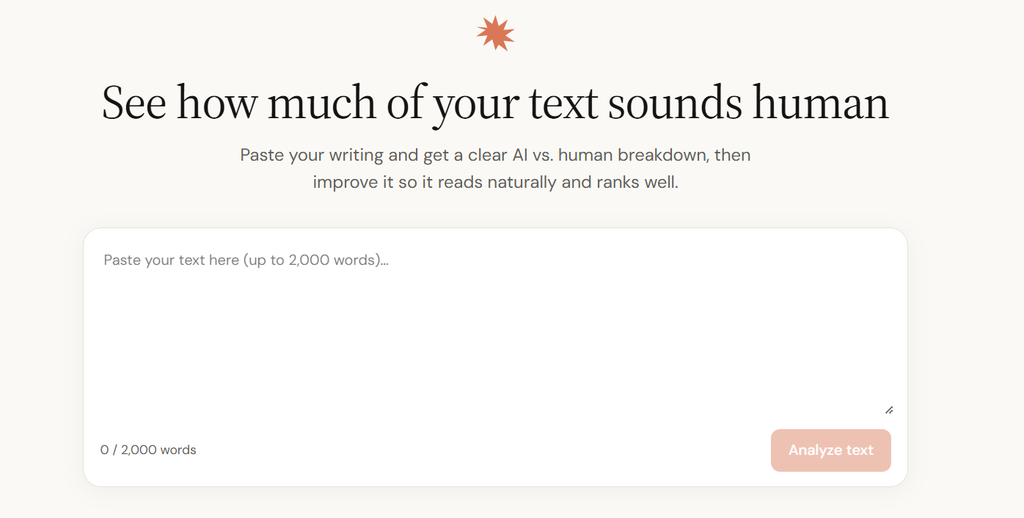
This is actually where ClaudeSEO does something a little different. Instead of just spitting out a pass/fail label, it shows you the actual AI ratio of your content — a more honest, nuanced number than a binary verdict. Because let’s be real: almost nothing published today is 100% one or the other anymore. It’s a mix. The question is whether that mix leans too far one way.
Do You Need a Paid Tool, or Will a Free AI Content Checker Do?
Honestly? Depends on your situation. There are plenty of decent AI content checker free tools floating around right now, and if you’re running a small blog on your own, one of those will probably get you 80% of the way there. Good enough to catch the obvious stuff.
Where free tools start to fall short is consistency — run the same article twice and you might get two different scores. They also tend to struggle with longer pieces, giving you one vague overall number instead of pointing to specific trouble spots. If you’re managing a content team or publishing at any real volume, that lack of precision gets expensive fast, even if the tool itself is free.
My honest take: start free. Build the habit first. Upgrade once you notice the free version isn’t giving you enough to actually act on.
A Workflow That Actually Works (Not Just Theory)
Here’s roughly what I do now, and what I’d suggest if you’re trying to build AI content transparency into your actual routine instead of just thinking about it occasionally.
Start with AI, but don’t stop there. Letting AI write your first draft is fine. Treat it like notes from an intern — a starting point, not a finished product.
Check it before you touch it. Run the raw draft through an AI content checker first. This gives you a baseline. If it comes back at 85-90%, you know you’ve got real work ahead. If it’s already sitting around 30-40%, you’re in decent shape.
Add something only you know. This is the part people skip, and it’s the part that matters most. A weird detail from your own experience. A number from research you actually did. An opinion you’re willing to defend. This is what makes content worth reading.
Check it again. After editing, run it back through your AI detection tool. The ratio should drop noticeably. If it barely moves, your edits were probably cosmetic — swapped a few words around instead of actually adding depth.
Disclose when it makes sense. If you’re in health, finance, or legal content especially, a short note mentioning AI assistance with human review isn’t a liability — it builds trust rather than breaking it.
Where ClaudeSEO Fits Into All This
This is really the gap ClaudeSEO tries to close. Rather than a vague “this looks AI-generated” flag, it measures the actual AI ratio of your writing in detail — section by section, not just as one overall score for the whole piece.
A few things about it that I’ve found genuinely useful:
It doesn’t just tell you yes or no — it shows you a breakdown, so you know exactly how much of the piece needs attention and how much is already solid.
It points to specific paragraphs instead of making you guess, which saves a ridiculous amount of time compared to rereading an entire 2,000-word article hunting for the robotic bits.
For teams managing multiple writers, it works almost like a quality-control layer — keeping everyone’s output consistent instead of having five different writers with five wildly different AI ratios across your blog.
And because content with a healthier balance tends to read more naturally and hold attention longer, using an AI content checker like this ends up tying directly back to actual SEO performance, not just some abstract compliance box.
Does This Actually Move the Needle on SEO?
I’ll be straight with you — I was skeptical at first too. But the pattern’s been pretty consistent across the content I’ve reviewed and edited.
Articles with a better human-to-AI balance tend to keep people on the page longer, simply because they don’t feel like they could’ve been written about anyone’s business, by anyone, for anyone. Bounce rates drop a bit. Dwell time goes up. And weirdly, these pieces tend to attract more backlinks too — because something with a specific angle or genuine insight is just more link-worthy than a rehash of the same ten points every competitor already covered.
None of that happens because you ran your article through an AI content checker one time and called it done. It happens when checking your AI ratio becomes as automatic as checking for typos — a habit, not an event.
If you use ChatGPT to draft posts, AI Content Transparency means disclosing that clearly.
Mistakes I See People Make Constantly
Trusting one tool’s score like it’s gospel. Different AI content detector tools use different methods, so scores vary. Treat the number as a guide, not a verdict carved in stone.
Editing just to beat the detector, not to improve the writing. I’ve seen people swap synonyms around purely to lower a score without adding anything of actual value. It might trick a tool. It won’t trick a reader, and it definitely won’t help your rankings long-term.
Dismissing free tools too quickly. An AI content checker free version still catches plenty. Don’t wait for the “perfect” paid tool before you start building the habit.
Treating disclosure as all-or-nothing. You don’t need a disclaimer on every single post, but certain niches are heading toward requiring it. Getting ahead of that now is a lot less painful than scrambling later.
Underestimating how long real editing takes. AI content transparency isn’t a five-minute task. It means actually sitting with your draft and asking, “would I have written it this way?”
AI Content Transparency also involves explaining how your data is used to train models.
Where This Is All Heading
This isn’t a passing trend, as much as some people want it to be. We’re already seeing early signs — platforms experimenting with AI labeling, search results favoring content with clear first-hand experience, and lawmakers drafting actual disclosure requirements in multiple countries.
For anyone writing online, the smart move isn’t avoiding AI tools out of fear — that’s just leaving speed and efficiency on the table while your competitors use it anyway. The smarter move is building a process where you’re honest about the mix, and where you’re consistently checking that mix with something reliable.
Running drafts through an AI content checker, reviewing what comes back with an actual critical eye, and layering your own perspective on top isn’t optional anymore if you want content that holds up over time. It’s quickly becoming just… how this works now.
Some WordPress plugins now generate automatic AI Content Transparency badges for posts.
Wrapping This Up
People love to frame this as humans versus machines, but that’s never really been the right way to look at it. The real win is figuring out how to use AI’s speed without losing the one thing it can’t fake — your actual experience and judgment.
Crossplag and other detectors are pushing the conversation around AI Content Transparency forward.
Tools like an AI content checker, an AI detection tool, or even a solid AI content checker free option aren’t there to catch you doing something wrong. They’re more like a mirror — showing you where your writing currently stands so you can decide what to fix and what to keep.
If you want your content to actually hold its rankings a year from now instead of just today, start treating AI content transparency as part of how you write, not something you bolt on afterward. Check your ratio. Edit with intent. And don’t shortchange the one thing AI genuinely can’t replace — your own voice in the final draft.