I won’t hurt your SEO if you use it right. Learn how AI content transparency, smart editing, and a reliable AI detection tool keep your blog compliant, credible, and ranking.
When I first started using AI tools in my content workflow, I told myself it was just for the boring stuff — outlines, research summaries, the occasional intro when I was staring at a blank screen at 11 PM. But somewhere along the way, “just for the boring stuff” quietly became “for most of the first draft.” And I didn’t have a clear process for what happened after that.
Sound familiar?
The content marketing world has shifted faster than most of us prepared for. And right now, one of the biggest professional conversations happening — in Slack channels, LinkedIn comments, and agency meetings — is about AI content transparency Not whether to use AI, but how to be honest about it, how to manage it, and how to make sure the content you publish actually reflects your expertise and not just a language model’s best guess at what expertise sounds like.
This guide is for marketers who are already using AI tools and want to use them responsibly. Not perfectly. Responsibly.
Let’s Talk About Why This Matters Right Now
Readers notice more than we give them credit for.
You’ve probably felt it yourself — you land on a blog post, start reading, and something just feels hollow. The sentences are technically correct. The structure makes sense. But there’s no personality anywhere, no specific detail that only someone with real experience would include, no moment where the writer reveals an opinion or admits something didn’t go as planned.
That feeling? It’s what AI-heavy content produces when nobody edits it properly.
AI content transparency is really about closing the gap between what you’re actually producing and what your audience believes they’re getting. When that gap gets too wide, trust breaks. And trust, once broken with an audience, takes a long time to rebuild — if it rebuilds at all.
Beyond audience trust, there’s a practical search engine dimension to this. Google’s helpful content systems are specifically designed to identify writing that was produced for algorithms rather than people. AI-generated content that skips meaningful human editing tends to check all the wrong boxes on that evaluation — generic structure, vague claims, no demonstrable firsthand experience. We’ll come back to this later.
What Rules Actually Exist Today?
Here’s the honest answer: it’s complicated and still evolving.
There’s no single global regulation mandating that marketers disclose AI involvement in blog posts or social content. But saying “there are no rules” would be misleading, because there are plenty of signals pointing in a clear direction.
Google’s actual position isn’t that AI content gets penalized — it’s that low-quality content gets penalized. Their E-E-A-T framework (Experience, Expertise, Authoritativeness, Trustworthiness) is the lens they use. AI-generated content struggles most with the first E. Experience. A language model trained on the internet doesn’t have experiences. It has patterns from other people’s experiences. That’s a meaningful difference when you’re trying to rank for competitive, expertise-driven topics.
Platform-specific policies are scattered but growing. LinkedIn encourages disclosure on AI-assisted professional articles. Amazon’s Kindle Direct Publishing now requires authors to flag AI-generated content. Medium has added tagging for AI involvement. Each platform is handling this differently, which creates a patchwork situation, but the direction they’re all moving is toward more disclosure, not less.
The FTC’s position is still developing, but their existing deceptive practices guidelines already apply to AI-generated reviews and testimonials that don’t disclose their origins. If you’re in the business of publishing endorsements or product content, this one deserves attention now rather than later.
The pattern across all of these is consistent: AI content transparency is becoming an expectation, even where it isn’t yet a legal requirement.
Understanding What an AI Content Checker Actually Does
Before you start building this into your workflow, it helps to understand what these tools are actually measuring — and where they fall short.
An AI content checker looks at your text and tries to calculate the probability that sections of it were generated by a language model. The main signals it uses are:
Perplexity — basically, how predictable is each word choice? AI tends to select statistically likely words in statistically likely sequences. Human writers make unexpected choices more often.
Burstiness — this measures variation in sentence length and complexity. Humans naturally write in a rhythm that rises and falls. AI tends to produce more uniform sentence structures across a paragraph.
Semantic flow — does each idea connect to the next in a way that feels like genuine thinking, or does it feel like assembled blocks?
Here’s the important caveat: no AI content detector is perfectly accurate. False positives are a real and documented problem. Non-native English speakers are disproportionately flagged because their writing patterns can resemble AI output in some technical ways. Academic researchers have raised legitimate concerns about the fairness implications of this.
What this means practically is that you shouldn’t treat any single tool’s score as a verdict. Use these tools as one signal among several, not as a final judgment on whether content is acceptable.
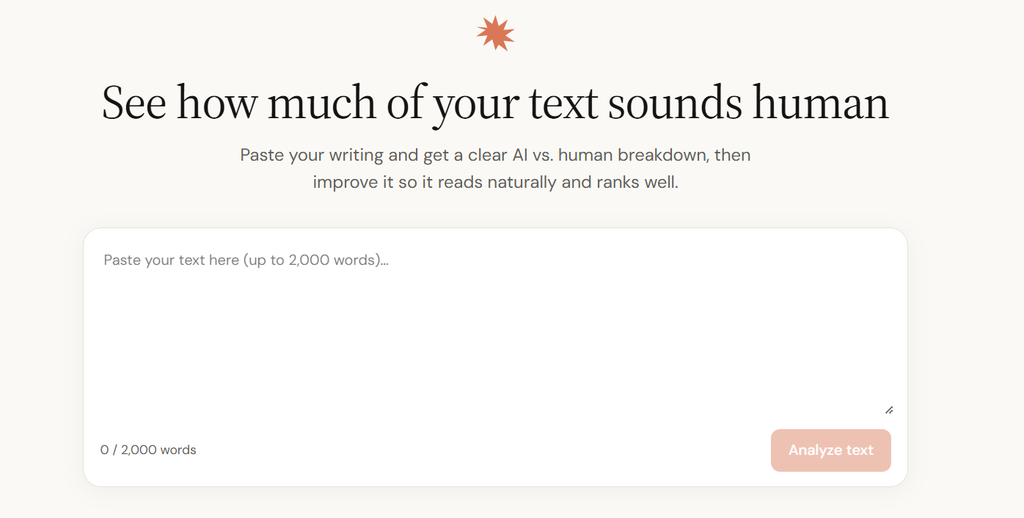
How to Actually Use an AI Detection Tool in Your Process
Here’s how I’d recommend building an AI detection tool check into your content workflow — not as a last-minute panic check, but as a standard part of editing.
Run your check early, not at the end. After your first revision, before your second, run the content through an AI content checker. This gives you actionable information while you still have time and energy to make real changes. Running it ten minutes before publishing just creates stress.
Look at which sections score highest, not just the overall number. Most tools will show you paragraph-level probability scores. The high-scoring sections are your priority. These are usually the intro, the transitions between sections, and the conclusion — the places where AI defaults to predictable, generic language.
Ask yourself a specific question about each flagged section: Is there something from my actual experience or research that could replace this? A real client situation? A counterintuitive observation? Something that happened in the industry recently that most people aren’t talking about yet?
If yes, replace the generic passage with that. If no, that’s a sign you might need to do more research or thinking before this section is ready.
Use an AI content checker free version to start if budget is a constraint. Several solid free options exist — they won’t give you the granular analysis of paid tools, but they’ll show you your overall ratio and flag the sections that need the most attention. Once you develop a feel for what high-AI content looks like on your own, you’ll start catching it without the tools anyway.
Building AI Content Transparency into your editorial workflow prevents future legal issues.
The Disclosure Conversation Nobody Wants to Have
Should you tell your readers when AI helped write something?
Most marketers change the subject when this comes up. I get it — there’s real uncertainty here, and the fear of looking lazy or inauthentic is legitimate. But avoiding the question doesn’t make it go away.
Here’s a framework that I think is actually workable.
Disclose when AI generated the bulk of what’s on the page. If you fed a prompt into a tool, got 800 words back, lightly edited them, and published that as your expert perspective — readers deserve to know. This doesn’t mean your content is bad. It means your process needs more transparency.
Use judgment when AI played a supporting role. If you used AI to create an outline, generate research summaries, or suggest alternative phrasings during editing, disclosure is less clear-cut. Many editors would argue this is similar to using any other writing tool, and they’re not entirely wrong.
Check your platform’s policy before you need to. Don’t wait until you have a piece ready to publish to realize your platform has specific disclosure requirements. Know the rules in advance.
One thing worth reconsidering: disclosure, framed the right way, can actually build credibility. A note that says “Research for this piece was assisted by AI tools. This article was written, edited, and verified by [Name]” signals that you have a process, that you’re not cutting corners on the thinking, and that you respect your reader enough to be honest. That’s not a weakness. That’s editorial integrity.
What Marketers Keep Getting Wrong
I’ve reviewed enough AI-assisted content at this point to recognize the recurring problems. These are the patterns that light up an AI content detector and, more importantly, that make readers quietly disengage.
Publishing without meaningful editing. The AI draft is the beginning. Treating it like the end is the most common mistake. Every AI-assisted piece needs a real human editor who’s asking harder questions than spellcheck asks.
Losing your brand voice across pieces. When different writers on your team use AI differently, and nobody is auditing for voice consistency, your blog starts to sound like a content farm. Readers notice this even when they can’t explain why something feels off.
Skipping fact verification. This one has cost real brands real credibility. AI tools fabricate statistics, misattribute quotes, and describe research studies that don’t exist — and they do it with the same confident tone they use for accurate information. Every factual claim from an AI-assisted draft needs manual verification. No exceptions.
Not establishing team standards. If you manage writers and nobody has written down what AI assistance is acceptable and what the review process looks like, you don’t have a policy — you have a situation waiting to become a problem.
Ultimately, AI Content Transparency is about honesty between creators and their readers.
Building a Team Policy That Actually Works
A workable AI content policy doesn’t need to be a lengthy document. It needs to answer four questions clearly.
What can AI be used for? Be specific. Brainstorming and research summaries are different from generating published drafts under a named author’s byline. Draw the lines explicitly so your team isn’t guessing.
What does the review process require? Who checks for factual accuracy? Who checks for voice consistency? Who makes the call on whether a piece is ready? Name the roles, not just the steps.
What’s your threshold for AI probability scores? Decide before you’re under deadline pressure. If your AI content detector scores a piece at 55% AI probability, is that a publish or a revise? Having a pre-decided standard eliminates a lot of uncomfortable judgment calls.
How do you disclose? Write it down. Even a simple internal standard — “We disclose AI assistance when AI generated more than a third of the original draft” — is better than having no standard. Put it in your style guide.
The SEO Connection Worth Understanding
Let’s be direct about the search engine piece, because it affects everything else.
Google’s helpful content system asks a set of questions about any piece of content. Does it demonstrate firsthand experience? Does it provide something you can’t easily find ten other places? Would someone who reads it actually leave satisfied? Is it clearly written by someone with real expertise in the topic?
AI content that hasn’t been meaningfully revised tends to fail most of these questions. Not because it was written by AI, but because AI defaults to generic when it isn’t guided and edited by someone who knows the subject deeply.
AI content transparency practices — when you actually apply them — force you to do the editing that makes content better. When you run your draft through an AI content checker, identify the weak sections, and replace them with specific experience and original thinking, you’re not just improving your detection score. You’re improving your content’s actual value. The SEO benefit follows from that, not the other way around.
AI Content Transparency should be a core value for any modern publishing platform.
The marketers who understand this are the ones building content programs that compound over time. The ones who are trying to hack around it are building programs that require constant maintenance to stay afloat.
Readers often skip articles when there is zero AI Content Transparency mentioned.
What Good Actually Looks Like
Here’s a concrete example worth thinking through.
A content manager needs a piece on supply chain disruptions for their B2B client. She uses an AI tool to pull together a summary of recent industry data and generate a basic structure. Then she sits down with the client’s operations director for 20 minutes and asks what they’ve actually seen in the past six months — which suppliers have been the problem, what workarounds they’ve found, what conventional advice has turned out to be wrong.
She writes the article from that conversation. The AI summary gave her the context. The conversation gave her the content.
She runs it through an AI content checker free tool. The score comes back at 12% AI probability. She adds a short note at the bottom about AI research assistance and publishes it under a real byline.
It ranks. People share it. Three people reach out to say it was the most practical piece they’d read on the topic in months.
That’s the model worth building toward. Not AI instead of thinking. AI alongside thinking, with humans doing the parts that actually require them.
A short disclaimer is the simplest form of AI Content Transparency you can add today.
Closing Thoughts
AI content transparency isn’t a compliance checkbox. It’s a reflection of whether you actually respect your audience.
The marketers who figure this out — who use AI tools efficiently, edit seriously, disclose honestly, and keep putting genuine expertise at the center of their content — are building something that holds up. The ones who are publishing unedited AI output and hoping nobody notices are running a short game that’s getting shorter every month.
Use your tools. Run your content through an AI content detector before it goes live. Build standards your team can follow consistently. And do the thinking that no tool can do for you.
Your readers are here for your judgment, your experience, and your perspective. AI can support all three. It can’t replace any of them.