What are actual AI Content Transparency Requirements? Not sure when you have to say a post was written with AI? Here’s a plain look at the laws, platform rules, and a few practical steps for publishing honestly.
A client asked me last month whether I needed to “put a label” on a post I’d drafted with help from AI. I didn’t have a clean answer. Turns out almost nobody does right now, because the rules are scattered across countries, platforms, and individual contracts, and they keep shifting underneath us.
So I sat down and actually mapped it out — partly for the client, partly for myself. Below is what I found: where AI content transparency is a legal requirement, where it’s just expected good practice, and how to build a policy for your own blog without hiring a lawyer. Quick disclaimer before we go further — I’m not a lawyer, this isn’t legal advice, and some of these dates will probably move again. Double-check anything time-sensitive before you act on it.
Why Anyone Cares About This
Strip it down and it’s really three things: people don’t want to be tricked, readers want to trust what they’re reading, and a handful of very ugly incidents forced governments to react.
The deception angle is obvious. Fake reviews, cloned voices, images of people saying things they never said — these cause real damage, and most lawmakers aren’t anti-AI so much as anti-being-fooled-by-it.
The trust piece is quieter but just as real. People increasingly want to know how something was made, especially when it touches health, money, or news. Hide that from them and get caught later, and the trust doesn’t come back easily.
And then safety. Deepfakes around elections, non-consensual fake imagery — these pushed several governments into fast, aggressive rulemaking. Which is exactly why the toughest laws target video, audio, and images, not a blog post where AI helped sketch an outline.
Worth sitting with that for a second if you’re a blogger. Most legislation is really aimed at synthetic media and bots impersonating humans. Plain text falls mostly under consumer protection law, platform rules, and whatever ethics you hold yourself to. Even so, AI content transparency is turning into a default expectation rather than a nice-to-have, and it’s a lot easier to build that habit now than retrofit it after readers start asking questions.
Europe Went First, and Went Big
The EU AI Act is the most detailed framework out there. Its transparency rules live in Article 50 and are supposed to kick in around August 2026, though the EU has floated adjustments before, so treat that date as “current, not final.” Roughly, here’s what it says:
People should know when they’re talking to an AI system — unless it’s painfully obvious. Companies that build tools generating audio, video, images, or text need to mark the output so it can be identified as machine-made. Anyone using AI to alter or fabricate content showing real people, places, or events has to say so. And AI-written text published on matters of public interest generally needs a disclosure — unless a human has reviewed it and someone is willing to put their name on it as the responsible editor.
That exception is the part I keep coming back to. The EU is drawing a line between raw machine output and content an actual editor checked and stands behind. If you run any kind of news or informational site, that’s reason enough to formalize your editing process and write it down somewhere — it’s the clearest real-world expression of AI content transparency I’ve come across in any of these laws.
Brussels is also drafting a code of practice on exactly how labels and markings should look, so expect more specifics soon. Fines for the biggest offenders can run into the millions of euros, or a slice of global revenue. A small blog isn’t the obvious target here, but if EU readers or clients are part of your audience, don’t assume you’re out of reach.
The US: A Lot of Pieces, No Single Law
There’s no federal statute saying “disclose your AI use” for ordinary content. What exists instead is a mix of agency enforcement and a growing stack of state laws that don’t always agree with each other.
On the federal side, the FTC leans on existing consumer protection law rather than anything AI-specific. A fake testimonial or synthetic endorsement that misleads someone can get treated as a deceptive practice regardless of what tool made it. Its 2024 rule on fake reviews specifically covers AI-generated reviews that misrepresent a real customer’s experience, and the agency has separately gone after companies for overselling what their AI products actually do. Congress has floated dozens of labeling and deepfake bills; almost none have passed. The one that did, the TAKE IT DOWN Act of 2025, deals with non-consensual intimate imagery, including AI-made versions of it.
States are moving faster. California’s AI Transparency Act requires large generative AI providers to offer free detection tools and bake disclosures into image, video, and audio output — though its start date has already been pushed back once. Utah requires disclosure in certain regulated interactions, and whenever a user sincerely asks if they’re talking to a machine. Colorado passed a broader AI law covering high-risk systems, now delayed into 2026. A handful of states have election deepfake laws too, some of which are tied up in free-speech challenges.
If you’re publishing in the US, here’s the practical version: don’t fabricate testimonials, don’t fake credentials, don’t impersonate real people with AI. Past that, disclosing AI use in ordinary text is mostly an ethics question and a platform-policy question, not a federal law question — at least for now.
Elsewhere in the World
A few Asian governments have moved further and faster than anyone in the West. China has regulated “deep synthesis” tech since 2023, and newer rules that took effect in September 2025 require both visible labels and hidden metadata, with the obligation falling on platforms as much as creators. South Korea’s AI Basic Act arrives in early 2026 and includes notice requirements plus labeling for output that could pass as real.
India has draft rules floating around for prominent labels on synthetic media. Spain has talked about steep fines for unlabeled AI content. The UK doesn’t have a dedicated labeling law, but its advertising regulator still expects AI-made ads not to mislead people, and ordinary consumer protections apply regardless of what made the ad.
Details differ everywhere, but the direction is the same: label the fake stuff, don’t deceive people, keep a trail of where content came from. Bloggers who embrace AI Content Transparency often see higher engagement rates.
What Google and the Platforms Actually Want
Statutes aside, platform rules are what most bloggers bump into on a Tuesday afternoon. AI Content Transparency means telling readers which parts were AI-assisted and which were not.
Google has said more than once that it doesn’t penalize content for being AI-assisted. What it goes after is content made at scale mainly to manipulate rankings — its own policies call this scaled content abuse. The framing it keeps pushing is who made this, how, and why, and it’s pretty blunt that when automation plays a big role, readers might reasonably want to know. In practice, a page with real human insight and an honest process tends to hold up fine. A page that’s unedited machine output, published by the hundred, does not.
YouTube, Meta, and TikTok all either require or heavily encourage labels on realistic synthetic or altered media. YouTube has a checkbox for exactly this. Meta and TikTok apply “AI info” tags, sometimes automatically off embedded metadata. Skip the label where it’s expected and you can lose reach or get content pulled — platforms increasingly run their own quiet version of an AI detection tool behind the scenes to catch this stuff.
And then there’s whoever you’re writing for. Publishers, journals, agencies — a lot of them have their own AI clauses now. Some ban AI text outright, some allow it with disclosure. Read the contract every single time; don’t assume last year’s agreement still applies. A lack of AI Content Transparency can damage your reputation faster than a slow website.
Watermarks, Metadata, and Why They’re Not Enough on Their Own
There’s a technical layer forming alongside the legal one. C2PA, sometimes called Content Credentials, attaches tamper-evident metadata to a file showing how it was made. Adobe, Microsoft, OpenAI, Google, and several camera manufacturers are behind it. Invisible watermarking — Google’s SynthID is the best-known example — embeds signals into generated images, audio, and text that software can pick up later. Governments in several countries are drafting laws around AI Content Transparency.
None of it is bulletproof, though. Screenshot something and the metadata’s gone. Paraphrase a text passage hard enough and a watermark can weaken past the point of detection. So these tools help with provenance, but they’re not a substitute for just telling people what you did.
Can Detection Software Actually Tell?
Partly, and that “partly” matters more than people assume. An AI content detector looks for patterns — very even sentence rhythm, oddly predictable word choices — and returns a probability. Not proof. False positives happen regularly, and they happen more to non-native English writers and to people who naturally write in a formal register. That’s part of why a lot of universities now tell staff not to treat a single score as evidence of anything.
That said, I still think an AI detection tool is worth having in your process — just not as a judge. Use it as a mirror. It’ll show you which paragraphs read flat or generic so you can go rewrite them with something specific. A solid AI content checker behaves more like a highlighter than a verdict. AI Content Transparency is not just ethical—it is becoming a competitive advantage.
A few things I’ve learned the hard way: never treat one score as final, talk to a writer directly about flagged sections instead of just forwarding a number, and run more than one tool if the stakes are high — when two detectors disagree, that disagreement tells you something too. Tools like Conch AI and Writesonic are indirectly promoting AI Content Transparency.
Actually Building a Disclosure Policy
You don’t need a legal team for this part. At its core, a disclosure policy is just AI content transparency applied to your own workflow, written down so you (and your readers) know what to expect.
Start by deciding what counts as “AI-assisted” on your site. Spell-check and headline brainstorming probably don’t need a note. AI drafting a section that a human then rewrote — that’s worth a short line somewhere. AI producing most of a piece — disclose clearly, because that’s what most clients and most emerging laws will expect anyway.
Keep the wording plain. Something close to: “This article was written by [name]. AI tools helped with outlining and editing, and an editor checked the final version for accuracy.” Stick it near the top, the bottom, or a footer page — doesn’t much matter where, as long as it’s findable. AI Content Transparency is becoming a major requirement for websites that publish automated articles.
Put a real name behind every post. Someone accountable for accuracy, someone a reader could actually email if something’s wrong. This matches both Google’s “who made this” framing and the EU’s editorial-responsibility carve-out, and honestly it’s just good practice regardless of any law.
Fact-check everything, always. AI tools will invent a statistic or a quote with total confidence and zero hesitation. Check numbers against a primary source every time — this is probably the single biggest gap between genuinely useful content and spam dressed up to look useful.
Label synthetic images too, especially realistic ones involving people or real events, and hang onto embedded metadata where you can. And keep your drafts and notes around for anything important. If a client or platform ever questions your process, having the paper trail settles it in about thirty seconds.
Getting the AI Out of the Writing (Even When AI Helped)
Disclosure is one half of this. The other half is just… writing something that doesn’t sound hollow. Raw AI drafts have tells — tidy three-item lists, claims with no edges, a tone that refuses to disagree with anything.
When I’m editing something like that, I add whatever only I actually know — a client story, a mistake I made, a number pulled from my own analytics nobody else has access to. I break up the rhythm on purpose, long sentence, then short one. Fragments too, sometimes. If I think a popular tactic is overrated, I just say that and explain why instead of hedging. I cut anything that opens with “In today’s fast-paced digital world” on sight. And I read drafts out loud — if a sentence would sound strange said to a colleague, it gets rewritten.
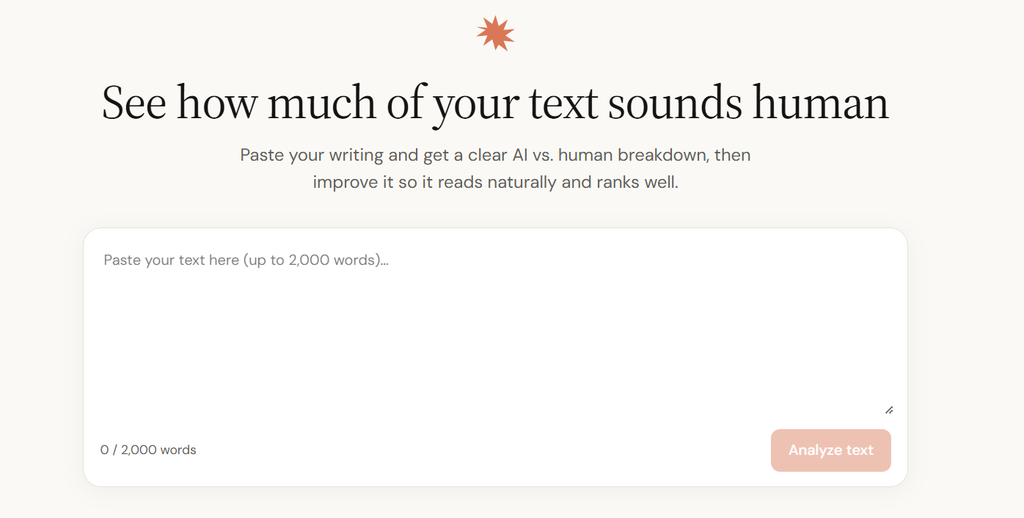
This is basically what Claude SEO is built for. It measures the AI ratio of a piece so you can see exactly which paragraphs still read as machine-written, go fix them by hand, and land somewhere that balances speed with an actual voice. Like any AI content checker, treat its score as a prompt to edit, not a grade to chase. If you’re testing the idea for the first time, there’s usually an AI content checker free option worth running for a baseline before you commit to anything paid — check your draft, rewrite the flagged bits yourself, then run it again. A quick pass through an AI content checker free before you hit publish tends to catch the most obviously robotic paragraphs in a few minutes, and that alone is often enough.
One caution though — don’t chase the score itself. A piece can read as “100% human” and still be thin and useless. A piece that leaned on AI for research can be genuinely excellent. Let the number nudge your editing. Don’t let it replace your judgment about what’s actually good.
Mistakes That Keep Coming Up
Hiding AI use where it’s explicitly required — contracts, academic work, regulated ads — costs far more than the one-line disclosure would have. Over-disclosing is its own problem too; slapping “this might be AI” on every page just confuses people without telling them anything useful. Relying on one AI detection tool as proof of anything is a mistake I see constantly, and it’s not actually how the tools work. Publishing unedited AI output at volume is the exact behavior Google’s spam policies describe, and it’s a fast way to lose rankings. People also tend to forget images and audio entirely, even though synthetic media faces the strictest rules almost everywhere. And don’t assume geography protects you — if your readers include people in the EU, California, China, or South Korea, local rules can reach you even if you’ve never set foot there.
Before You Hit Publish
A few questions worth running through: Does a contract or platform actually require disclosure here? Have I told readers, in plain words, what AI did and didn’t do? Is there a named human who fact-checked this? Are any realistic synthetic images or audio labeled? Does this include something only I could have written — an opinion, a number, a story? Did I run it past an AI content detector as a sanity check and fix the flat parts? And do I have drafts or notes saved in case anyone ever asks?
Answer yes to most of those and you’re already ahead of a large share of what’s being published right now.
Quick Answers
Do I legally have to disclose AI use in a blog post? Mostly no, not yet, for ordinary text. Contracts and platform rules might require it anyway, and the EU’s incoming rules on public-interest content will tighten this further.
Does Google punish AI-assisted writing? Not for the AI part. It punishes low-value content made at scale to game rankings. Accurate, human-checked writing holds up fine either way.
Can I trust an AI content detector’s score? Treat it as a hint, not a verdict. False positives happen, and non-native writers get flagged more than they should.
What should a disclosure actually say? What AI did, what a human did, and who’s accountable. Short beats long here.
Are the rules stricter for images and video? Yes, pretty much everywhere, especially anything realistic involving actual people.
Where This Leaves Us
Nothing about this area is settled, but the direction is obvious enough: label synthetic media, don’t mislead people, and be ready to say who’s accountable for what you publish. AI content transparency was never about swearing off AI tools — it’s about being honest regarding your process and owning the result.
Start small if this all feels like a lot. One short policy, one named editor per post, real fact-checking, and detection tools used as a mirror instead of a courtroom. Keep that up and you’ll be fine no matter which law lands next — and your readers will trust you more for it in the meantime.